How much does a wedding actually cost in 2026?
We added it up — venue, food, photographer, the parts no one warns you about — and laid out where every dollar tends to go in a 2026 wedding budget.
By Filmo Studio
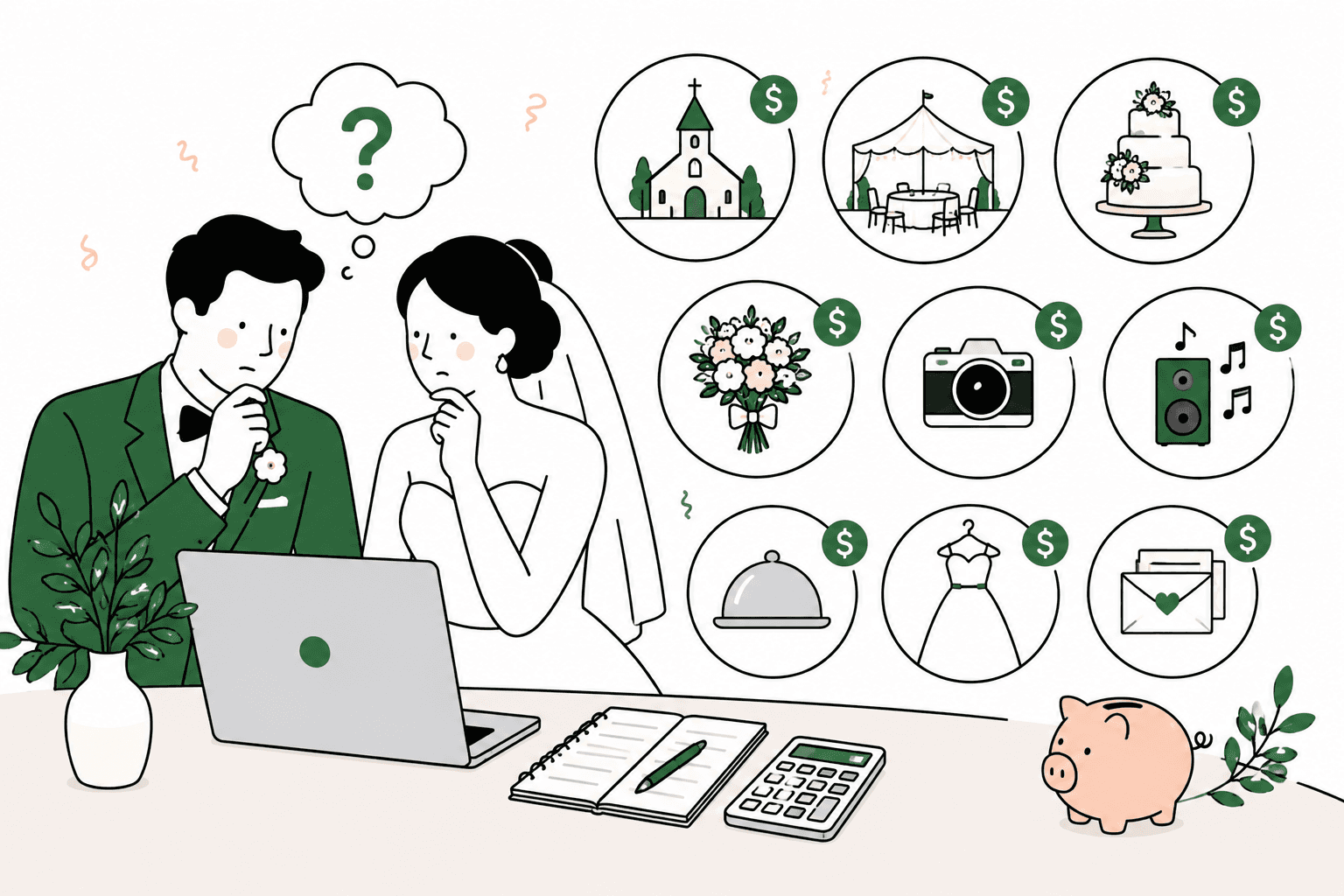
Average-wedding numbers are useless for planning. They mash together a $9,000 backyard ceremony with a $90,000 destination event and produce a single figure that helps nobody. What follows is a more useful frame: a category-by-category breakdown of where 2026 wedding budgets actually go, with rough percentages, so you can map your priorities against them.
All numbers below assume a guest count of around 80 — the median real-world wedding in North America and Western Europe in 2026 — and are inflation-adjusted from the most recent The Knot, Hitched, and ReWedding industry reports.
The headline number
The average all-in cost of a wedding for ~80 guests in a major metro in 2026 sits around $33,000 USD (€31,000, £26,500, R$170,000). The median is lower, around $24,000, because a small number of very expensive weddings drag the average up. Both numbers exclude the engagement ring, the honeymoon, and what the couple's families spend out-of-pocket on travel.
Where the money goes
Round percentages, drawn from real receipts:
- Venue + reception space: 28%. Often bundled with food minimums, which is why this number is misleadingly low on paper.
- Catering and bar: 22%. Per-head food costs went up sharply in 2024–2025 and have stayed high. Plated dinners cost roughly 30% more than family-style or stations.
- Photography (and video, if you book it): 12%. A working wedding photographer in a major metro charges $4,000–$6,000 for a full day in 2026. Adding video pushes this to 18%.
- Florals + decor: 10%. The category that absorbed the largest cost increase post-2023, partly because of cut-flower import costs.
- Attire (dress, suit, alterations, accessories): 7%.
- Music + entertainment: 6%. DJs run $1,500–$3,500; a five-piece band runs $4,000–$8,000.
- Stationery, signage, favors: 4%.
- Officiant, marriage license, paperwork: 1%.
- The miscellaneous bucket — transport, lodging blocks, hair and makeup for the wedding party, vendor tips, day-of coordinator: 10%.
What the breakdown doesn't tell you
Three lines on the budget tend to get under-funded by first-time planners, in our experience and in the industry data:
1. Day-of coordination
A day-of coordinator costs $1,500–$3,000 and is the line item with the highest return on investment in the entire budget. A planner who runs the timeline so neither family nor wedding party has to is the difference between "I remember my wedding" and "I remember a sequence of small disasters at my wedding." If you can only add one thing to a tight budget, add this.
2. Photo coverage of the night
Most photographers wrap their hours around dinner. Reception coverage is often capped at 60–90 minutes after the first dance. The dance floor at midnight, the cab queue at 2 a.m., the after-party — those don't show up in the official album because the photographer was contractually allowed to leave. This is one of the reasons couples are pairing official photography with a guest-shot candid layer (whether that's a literal disposable, a film-style camera app, or Filmo).
3. Vendor tips
Add 5% to your hard budget for tipping. It is real money and almost no online wedding-cost calculator includes it.
How to cut 30% without it feeling like you cut anything
Three moves do most of the work, in roughly this order of return:
- Get married on a Friday or Sunday. Venue and vendor pricing for non-Saturdays runs 15–25% lower across the board, and almost no guest will notice.
- Stations or family-style instead of plated. Saves around 30% on catering with no perceived downgrade — often, the opposite, because guests stay seated together longer.
- Hire your photographer for fewer hours and put the night under your own roll. Most couples don't need eight hours of professional coverage. Six is enough for the ceremony, portraits, dinner, and first dance. The candid layer for the rest of the night is something guests will document better anyway.
What the average wedding looks like, line-by-line
If you want a single example: a typical $24,000 wedding in 2026 looks something like $6,700 venue, $5,300 catering, $2,900 photo, $2,400 flowers, $1,700 attire, $1,500 music, $950 stationery + favors, $250 officiant, $2,300 day-of and miscellaneous. That is a real wedding, not a magazine wedding, and it covers ~80 guests well.
If you can hit those rough proportions, you're not going to wake up wondering where the money went.
Start your own roll
Your next event deserves an album that develops on its own time. Free for up to 5 guests, no card required.
Create a free eventKeep reading
 Weddings
Why a disposable camera (or its modern cousin) belongs at every wedding
The official photographer captures the day. A disposable roll captures the night. A short field guide on why pairing the two is becoming a quiet wedding standard again.
Keep reading Hosting
How to print event QR signage that guests will actually scan
A short, opinionated guide to QR signage at parties — placement, copy, and the one thing that matters more than the design.
Keep reading